One dimensional frequency domain project


Instructions


  1. Remember to carefully read the information provided on this page.
  2. You can use any edition tools for writing down your report; it means: Office, LibreOffice, Google-Document, Overleaf.
  3. The final version of your report will be delivered in .pdf format and limited in size to 10MB.


Cover


Your report must start on the first page with a cover. Make your election of a professional cover. Don't use school logos. The following site contains examples of suitable covers Plantillas para portadas de informes.

Objective


Include the following objective on the second page:

"The student will create a sound equalizer for processing a .wav audio file using Python and the techniques reviewed in class sessions to process a recorded audio."


Limitation of the study


Include the following statement on the second page.

"We are not interested in processing audio by chunks or to improve the filtering latency. Our main purpose is to apply the filtering techniques reviewed in class sessions and required to process an audio file."


Material


Report the following resources you have used for your work. This information can be captured on the second page.

  1. Computer: laptop or desktop (required to report).
  2. Google Collaborative (required to report).
  3. Python (required to report).
  4. An audio file from Internet.


Research


Recomendations


To invetigate

  1. You will need the article "All about audio equalization: solutions and Frontiers" and from the "1. Introduction, first paragraph" take information to answer the following three questions. The article can be reported as:

    APA
    [valimaki; 2016] Välimäki, V., & Reiss, J. D. (2016). All about audio equalization: Solutions and Frontiers. Applied Sciences, 6(5), 129.

    ISO 690
    [valimaki; 2016] VÄLIMÄKI, Vesa; REISS, Joshua D. All about audio equalization: Solutions and Frontiers. Applied Sciences, 2016, vol. 6, no 5, p. 129.


  2. What is the origin of the term equalizer?

    • 1 point for reporting the answer.
    • 1 point for reporting correctly the bibliography reference: The answer is needed to qualify this point.


  3. What the purpose of equalizing the received signal?

    • (1 point) for reporting the answer.
    • (1 point) for reporting correctly the bibliography reference.


  4. What is the current use of equalization?

    • (1 point) for reporting the answer.
    • (1 point) for reporting correctly the bibliography reference.


  5. Choose an artificial intelligence software and ask it, "What is a shelf filter?" Write down the answer. Ask the artificial intelligence to create a bibliographical reference to the answer it has generated. The following paragraph is an example of a reference.

    [gemini-shelf; 2025] Modelo de Lenguaje de Google. (2025, 22 de marzo). Filtro de estantería.


    In the text use the label [gemini-shelf; 2025 ]


  6. You will need the article "All about audio equalization: solutions and Frontiers" and from the "3. Parametric equalizers: first paragraph" take information to answer the following two questions.

  7. What are the three adjustments of midrange bands?

    • (1 point) for reporting the answer.
    • (1 point) for reporting correctly the bibliography reference.


  8. What is the use of "notch filter". Figure 5 in the article shows several frequency responses of notch filters that you can use as part of your response.

    • (1 point) for reporting the answer.
    • (1 point) for reporting correctly the bibliography reference.


Special note


For works suchs Theses and Articles, the consults to language model can be used as reference, however, it is preferable to include such references as footnotes and indicate that the definition is a starting point.


Project


  1. You can use any of the following audio samples for your project: one left clikc to reproduce, right click to choose download the link.


    Also, it is possible to use any other audio; however, you will need to be careful about the sampling frequency fS=11025, one channel and the data format.

  2. Investigate how to obtanin the following features of a .wav file using Python:

    • Number of channels (1 point for report it).
    • Data type (1 point for report it).
    • Sampling rate in Hz (1 point for report it).
    • Number of samples (1 point for report it).
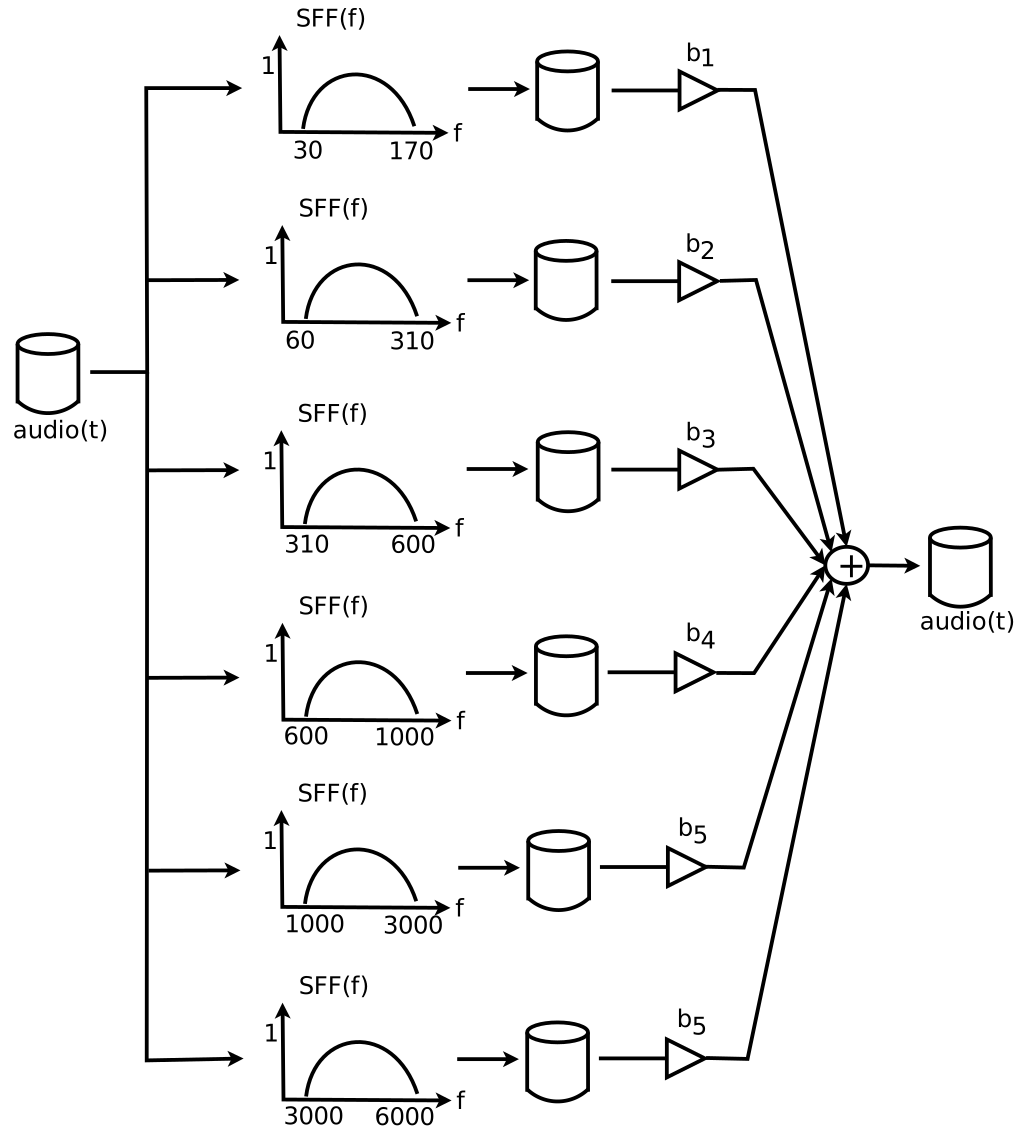

  3. Given the following specifications, design a set of digital filters to equalize the audio file.


    • If you are going to use the audio samples, regard a sampling frequency of fS=11025Hz for your designs.
    • Given the specifications, the type of filter is Butterworth.


    • 1 point for the transfer function of the filter 1.
    • 1 point for the transfer function of the filter 2.
    • 1 point for the transfer function of the filter 3.
    • 1 point for the transfer function of the filter 4.
    • 1 point for the transfer function of the filter 5.
    • 1 point for the transfer function of the filter 6.
    • 1 point for the frequency response of the filter 1.
    • 1 point for the frequency response of the filter 2.
    • 1 point for the frequency response of the filter 3.
    • 1 point for the frequency response of the filter 4.
    • 1 point for the frequency response of the filter 5.
    • 1 point for the frequency response of the filter 6.


  4. Report:

    • 1 point for reproducing the original audio.
    • 1 point for reproducing the equalized audio.


Evaluation